Archive for the ‘Attitude’ Category

qualities


You’ll notice that this post doesn’t have a survey, just results. That’s because the original survey tool, Polldaddy, now charges for use of its tool. As a result I have moved to Surveymonkey, which you’ll see in use from now on. For older surveys, I have included the results in the original blog post.

Swearing in a New Language

Posted: October 22, 2011 in Attitude, Technique

American males, of which I am a card-carrying member, are brought up in a culture where we are given Army men as kids, play cops and robbers with toy guns, play fight with one another, and are pretty obsessed with video games, which are oftentimes rife with death and first person shooter smackdowns. Turning on the TV, going to the movies, or going on the Internet, we are further exposed to loads of violence. Testosterone coursing through  our veins and possessing the ability to recite lines from ‘Pulp Fiction’ from memory, we are lulled into a sense that we truly understand violence and can take care of ourselves in a fight. “How hard is it to throw a punch?” we scoff. “I’ve seen ‘Enter the Dragon’ 14 times and listen to Rap music. I’m a BADASS!”

Every human being is capable of fighting.  But one only has to watch an average school fight or two to see that this is not the case.  Street brawls and schoolyard tussles tend to be brief, violent, but also comically frenetic. Face it, we don’t know how to fight (or fight well) and our punches, learned mostly by watching Clint Eastwood or Jason Statham, well….suck. We can pose and practice in the mirror, strut down dark alleyways like we mean business, but do most of us truly know how to handle ourselves in a throwdown? Probably not.

Many of us turn to martial arts. Broadly, I think it’s fair to categorize them, at least for this blog post, as traditional and reality-based self-defense styles. Styles like Karate, Kenpo, Tae Kwon Do, and Judo are in the former category while styles such as Krav Maga and Haganah fall into the latter category. Both are fine ways to go and neither category is inherently better than the other, let me make that perfectly and abundantly clear. It’s all good. [See “My Style Can Beat Up Your Style!” for more on this subject]. What I have been thinking about a lot lately, though, is how quickly any technique can be made part of one’s natural behavior when one finds themselves in a confrontation.
Let’s take learning a foreign language as an example to illustrate my point. It takes a long time to learn a new language. We fumble around with new words and phrases but ultimately become serviceable if we stick to it long enough and give it a lot of practice. Let’s say we move to France and become fully immersed in the culture — we’re surrounded by people speaking French 24 x 7. We go down to the bowling alley with our French friends and during the last frame drop a bowling ball on our big toe, crushing it to a pulp. In this case, as an American who’s been brought up speaking English, what do we say? “SHIT!!!” not “MERDE!!!!”  English is natural and comes easily to us. Our brain is wired this way because that’s how, from birth, we have learned to communicate verbally with others. In this example at the French bowling alley, this immediate need to express our intense dissatisfaction with our toe being crushed by the ball we don’t even have to think about how to curse. The English version of the expletive comes to mind automatically without a conscious thought.

Same is true of self-defense in the martial arts. In my brief exposure to Uechi-ryu some 20 years ago, and seeing my daughter and her fellow students’ experience in Kenpo class, traditional martial arts take a while to feel natural. For the first several months it feels awkward and unnatural for most and in most styles. I remember feeling this way in particular with the stances in Uechi-ryu. A fine, fine style and I mean no disrespect but I really had a hard time imagining falling naturally into the fighting stance if I entered into a confrontation. It just felt weird to me. Still kind of does. If I were to be attacked within the first several months of training I strongly suspected I’d fall back on my “natural” fighting instincts (i.e., flailing around with wild, ineffective punches) rather than the fighting techniques I had recently been exposed to.

What I like so much about Krav Maga is how natural it feels. I have only been training for 4.5 months, 3 – 4 times a week but — even in that short time — I feel like I would feel completely natural employing these techniques in the real world. They make sense and don’t feel awkward to me.

Again, I am not rating one type of style over another style. That’s not my point. Over time, any style will feel natural to the student and would be extremely effective in any combat situation. What I’m saying is that Krav Maga just seems to make that connection so much quicker. By design, it’s meant to be assimilated easily, rapidly, and takes advantage of your natural reactions. Sure, it takes a lot of work, sweat, and time to be truly great at it but the basics ought to come naturally; a student shouldn’t have to think about falling into particular stances and the order of a particular kata flows.

No sane person wishes a confrontation but if I ever find myself in that unfortunate situation I am positive that I’ll be swearing in French.


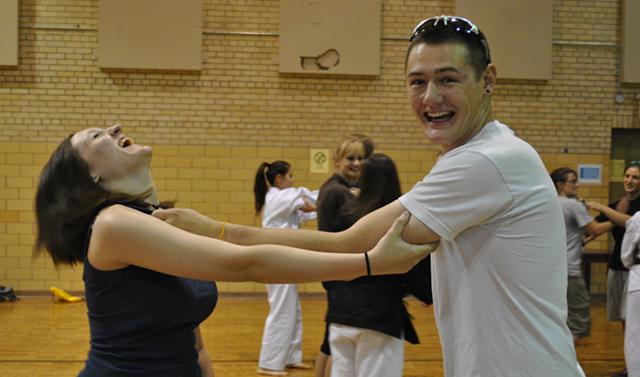
This past week was the school’s semi-annual Buddy Week where any student could bring in a friend, roommate, co-worker, spouse, or other unsuspecting family member to Krav Maga class for a couple of free training sessions.

It wasn’t a full bore training week, to be sure. Given the presence of many inexperienced people in our midst (and the fact that the school was supposed to be enticing them, not punishing them) we “shifted down” the intensity somewhat throughout the week and focused again on many rudiments that serve as the foundation to the more advanced teachings.

I saw this week’s influx of people as a very different brand of person than incoming White Belts in a lot of ways. White Belts have made the mental commitment to get into Krav Maga and the ballsy move of stepping into class. This is tough for everyone as everything is new and the unexpected is around every corner. The ‘Buddies’ who came in, on the other hand may have been dared to show up, shamed into coming, or were just ducking in for a class or two to see if this martial art from The Debt, Enough, and Channel 25 News was everything it was cracked up to be. They hadn’t, in nearly every case, made that same gigantic mental leap that a new White Belt makes. It wasn’t necessarily a joke to be in class but in some cases, it wasn’t too far from that. There was a fair amount of laughing, some clowning around, and flat-out talking during our drills’ instructions. None of these were remotely cool and anyone with any common sense should have been able to see that.

This week the instructors were in a bit of an odd situation. They couldn’t start barking at the noobs for a couple of reasons. This would have made the sponsor student who brought them in feel like a tool and it probably would have decreased the likelihood that the Buddy would sign up at the end of the week for a one-month trial — ultimately the real goal of the week when it gets right down to it. This left the instructors a bit more permissive than they ordinarily might have been in these situations.

Wheeeee!

Anyhow, back to the theme. What was the lesson? Well, as I watched the Buddies I could really equate them as People Right Off The Street. Again, as explained above, these weren’t really even White Belts — they were regular people, folks you might encounter in the real world and were the closest approximation to an Average Citizen we would see in school. As such it made it a very interesting exercise to “measure” myself against them. Not in an arrogant kind of “I’m better than you” sort of way but rather in a way that says that this is what I was a little like before thinking about starting up with my training. No, I’m not a superior human compared to the Buddies because of it. I see how these months have shaped me into a more disciplined person though. I don’t whine in class when we do 10 minutes of ab work. I don’t roll my eyes when we don’t get a break. I don’t chatter during class or giggle off to the side with other students. I pay attention, I show respect, and I work my ass off at all times.

I’ve developed a harder, can-do mindset since starting and I’m here to work. Sure I have a very long way to go, a lot of technique to learn, and many bad habits to break. But I can see, as a side-by-side comparison with the Buddies this past week, that I have made tremendous strides in my development and should take a moment to appreciate and reflect on all that this school has brought to my character and physical state since starting this past June.

Belts as Goals

Posted: August 16, 2011 in Attitude, Belt Test, Belts, Older

At our recent belt ceremony we heard more about what belts mean at our school. The topic of belts is a very touchy one for some and a very engrossing one for others, oftentimes depending on where a person is on the ‘belt continuum’.  Observation has led me to believe that more advanced students claim to think less about belts than newer students. Anyhow, what made this talk interesting was that it gave us another way to think of the belt. Many of us who train in martial arts see the belt as a reward and there’s no doubt that it is indeed that.  But it is actually something more.

The reason that our school grants so many belts when compared to many other Krav Maga schools is that belts are seen as goals.  Our school Master told us that when he first obtained his Black Belt he asked, “What next?”. He had been conditioned over the years to never be satisfied that “that was it”.  He has been training in martial arts since the age of 11 and this is one of the most important lessons he has gained from it: to set goals and always look for the next step — how to improve and get to the next level of greatness.  It’s his and the school’s philosophy that belts provide those incremental steps to get to your ultimate end goal, the Black Belt and beyond.

One analogy he gave us is the old adage of:

“What’s the best way to eat an elephant? One bite at a time”.

This is, in his opinion, the way to achieve the long-term goal of Black Belt. And what better way to do it in martial arts than defining belts that are not strung out by many months. One could argue that belts separated by a longer time interval serve the same purpose, I suppose. What is truly the difference between a belt being granted every 3 months vs. every 12 months, right? I think, as a matter of personal preference, that the difference is there and appreciate the smaller increments.  Again, to paraphrase, the school Master said if he were to set out to lose 20 pounds in 2 months he wouldn’t make that his only goal. It’s too big and tough to measure progress against and could be frustrating and overwhelming. Instead he would first figure that he’d need to lose 10 pounds a month, which means 2.5 pounds a week.  This is how the Black Belt journey is subdivided.  Assuming the average student requires 4 to 6.5 years of training to achieve that level of mastery and proficiency, the journey is divided by rough intervals by belts (and some of the belts further divided by stripes).

In the end, the belt to us now looks a little different. Yes, it’s a measure of our experience and time spent training.  But now, thanks to that talk, we can now recognize it for something even greater — a tangible goal that we can aspire to attain through hard work and dedication every day we spend in class.

This week’s lesson came to me courtesy of trying to be a nice guy.  Oh, this sounds like an enticing lead, doesn’t it?  Well, before your imagination runs too far afoot let me stop you right there.  Nothing really intriguing led me to this; rather, it was simply taking turns pad-holding and driving knees with a partner.

My partner was a young guy I’ve struck up a dojo friendship with over the past month or so.  He’s a good guy but probably weighs half as much as me and is a good foot shorter. Pairing up for the exercise he expressed concern that I’d knock him through the back wall with my knee strikes as he held the pad but I assured him all would work out.

I was up first with my knee drives and my partner held the tombstone pad, expecting the worst.  I drove a couple home and heard some grunts, leading me to tone down the power a tad. A minute or so later we changed sides and he was up. He drove knees into the pads relentlessly. Good power and focus; I was impressed. I was also getting quite a rib workout too, to my chagrin. My feelings weren’t hurt but it was then that I realized — as nothing stood between me and some high-powered knees but a vinyl covered firm foam pad, looking downward as drops of my perspiration were shaken to mat from my damp hair with each successive and violent impact — that there is no mercy in training.

What I learned is that we’re here to train and these exercises are as much for the pad holders benefit as the student performing the technique.  I have to remember to put my all into it because, in most cases, I’m going to get whatever I’m giving when it comes my turn.

Sure you can’t take this to the extreme. There are some notable size differences between students for sure and putting someone on the Pain Train isn’t what I’m talking about here. In fact, one burly student took it upon himself to go full force with a much smaller female student and ended up sending her to her doctor with bruised ribs. What I am talking about, in general, is that there is no more holding back like that in training when it comes to intensity, no more punches being pulled.  This isn’t ballet and we aren’t knitting hats; we’re learning self-defense and the gloves are off.

I know you’ve heard it before.  Heck, if you’ve been training in a particular martial arts style you may be guilty of this yourself. Martial arts style elitism.  Otherwise known as “my style can beat up your style”.  Here’s a fun experiment: go to Youtube and find a video on martial arts.  Go ahead.  Anything. If you are feeling lazy try this one or this one or this one.  Then, go to the comments below and scan them.  Painful, isn’t it?  I wouldn’t recommend doing this too often as studies have shown that frequent reading of Youtube comments can lead to brain damage or dementia.

As human beings, we are hard-wired to take immense pride in groups or clubs we belong to.  When a child is put on one of the four academic teams you’ll see immediate pride in that team.  The team is the best, the other team stinks!  You see it on reality shows like Survivor when teams are broken out by men vs. women or Purple buffs vs. Yellow buffs. It’s human nature to band together and immediately create an “us vs. them” mentality.

I think the same is true with martial arts styles and schools.  Once you commit to a school and a martial arts style you’ve created a baseline perspective, a lens through which you see other styles and schools.  It becomes very personal.  “That style has more kicks than mine”. “That style involves more grappling than mine”.  “That school has more students”. “That school has bigger jerks”.  This is a heated argument that has gone on since the second martial arts style was invented and students learned of each other’s existence.

I don’t think I’m going out on a limb by saying that most martial artists are male.  And of these, there’s a contingent of testosterone-soaked, pimple-faced braggarts who will always take school/style pride a little too far.  Is BJJ superior to Muay Thai?  Is an MMA fighter the ultimate badass?  Can a black belt in Judo kick a black belt in Karate?  Does School X have lower attrition then School Y?  It goes on and on.

In the end, there is no “best” style.  There are “different” styles, all with their strengths and weaknesses.  Yes, some schools and instructors are better than others — sometimes immensely — so choose wisely.  Looking objectively at it, I think I lucked out with my school and my style.  Is it perfect?  Absolutely not.  There are a couple things I would change or at least tweak a little.  However, Krav Maga has most of the elements I was looking for in a workout routine and martial arts style and my school is clean, close to my house, and fits my needs.  What more could I want?

I think it really all comes down to your goals, your learning style, the make up of a martial arts style and how it blends with your style, and the qualities you look for in an instructor and school.  If you can find good alignment with these attributes I think you’ve done well.  Shut out the naysayers, trolls, buzzkills, and malcontents who are running about banging their style’s gong.  Get what you want out of the experience and quietly smile as the pointless debate rages on.

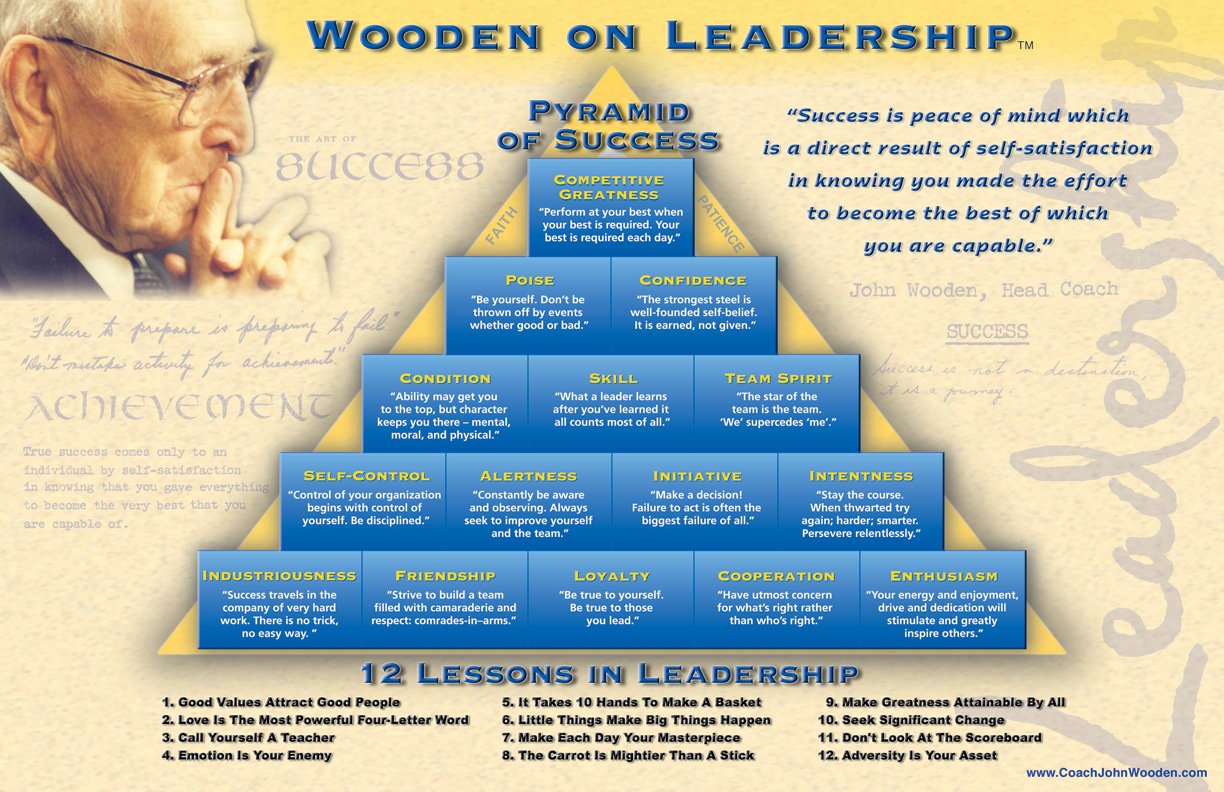
This is an amazing talk by an incredible human being, John Wooden, famous basketball coach legend at UCLA.  There are so many lessons in this talk and the majority of them apply directly to martial arts training.  I pulled a lot of wisdom from this 17 minute talk.  Hope you can too.

For reference, here is the pyramid that is held up in the talk.  It’s useful to print out and keep handy.  Again, it’s surprising how many principles outlined on Mr. Wooden’s pyramid tie directly to work ethic in the dojo.

Photo by marcobdz via Creative Commons License. http://www.flickr.com/photos/marcovdz/

I had a controversial discussion with a Red/Black Belt the other day and I have been pondering it on and off since.  During my stretching routine we struck up a conversation that somehow led to other martial arts styles and how they differ in philosophy from Krav Maga.  This is how it went:

Them: Krav Maga is all about self-defense, not necessarily about “fighting”.

Me: What do you mean?  What’s the difference?

Them: See, most other styles have a strict emphasis on form and katas.  Not to take away from any of these styles but sometimes their philosophy is that martial arts is a sport — competitions, points, trophies won in fights.  Krav Maga, on the other hand, is about self-defense and “making it home safe”.

[Poses in a fighting stance]

This is fighting. [Moves around, does some forms, and bobs and weaves]. This is self-defense [Moves in rapidly for the takedown].

Other styles can be really devastating in their own right but they have a very different mindset from Krav Maga.  Krav Maga is instantaneous and designed to end the situation as quickly as possible with no flair, no trophies, no points, no hesitation.  This is probably why it isn’t in tournaments. It’s designed as a practical street self-defense and not as a sport.

Interesting perspective.  Now, don’t take this too seriously; I am not saying this is the school’s or KMW’s position on the topic — or mine for that matter — but it was an interesting and somewhat controversial thought. I can imagine someone from another style reading this and blowing a gasket (maybe being justified in doing so).  In either case, food for thought.

“Fighting vs. self-defense” turns to be a pretty rich topic with a LOT of legal implications and different facets. For example, another completely different angle to it is thinking about self-defense vs. fighting outside the dojo or ring.  If you are on the street, self-defense is employing your skills when you are the victim of an unprovoked attack.  This is 100% legal. Fighting, on the other hand, is not legal and could be defined by a layman like me as being engaged in a physical altercation with someone as a result of an escalation of a disagreement between two or more parties.  Someone named Shawn Miller on KarateForums.com said that in his mind, “Fighting is something done for ego, pride, or honor. Self defence is life protection of you, family and friends. No rules, no care of repercussions.”  Well said.

If you want to read a little more about it do a search on the web and you’ll see many pages that discuss this, like here and here.

Back to the main point made in the post, what do you think?  Agree or disagree?

Motivation from Bruce Lee

Posted: June 23, 2011 in Attitude

I ran across this passage written by a student of Bruce Lee’s who used to train with him.  I believe the original quote is from a book called “The Warrior Within“, a compilation of Bruce Lee’s philosophies written by John Little.  Even if you’ve read this before, do yourself a favor and read it again.

Bruce Lee really had some guts and dedication and this glimpse into his psyche and work ethic is deeply admirable.

Bruce had me up to three miles a day, really at a good pace. We’d run the three miles in twenty-one or twenty-two minutes. Just under eight minutes a mile.

So this morning he said to me “We’re going to go five.”

I said, “Bruce, I can’t go five. I’m a helluva lot older than you are, and I can’t do five.”

He said, “When we get to three, we’ll shift gears and it’s only two more and you’ll do it.”

I said “Okay, hell, I’ll go for it.”

So we get to three, we go into the fourth mile and I’m okay for three or four minutes, and then I really begin to give out. I’m tired, my heart’s pounding, I can’t go any more and so I say to him, “Bruce if I run anymore,” –and we’re still running-”if I run any more I’m liable to have a heart attack and die.”

He said, “Then die.”

It made me so mad that I went the full five miles. Afterward I went to the shower and then I wanted to talk to him about it. I said, you know, “Why did you say that?”

He said, “Because you might as well be dead. Seriously, if you always put limits on what you can do, physical or anything else, it’ll spread over into the rest of your life. It’ll spread into your work, into your morality, into your entire being. There are no limits. There are plateaus, but you must not stay there, you must go beyond them. If it kills you, it kills you. A man must constantly exceed his level.”

Bruce Lee

I don’t care who you are, it’s never easy being at the bottom of the pecking order.  It can be at work, at school, or at the local book group.  Being the “new guy”, the most junior, the least skilled of the group is never an easy thing.  This is even more evident in a physical, adrenaline-fueled activity such as martial arts.

Day One is tough for so many reasons. You’re nervous, anxious, often confused, out of shape, and completely surrounded by people who know more than you.  This is particularly difficult if you are middle-aged, successful at work, and have a family. Why? Well, you are used to calling the shots in many areas of your life and making rules that are followed. People look up to you and follow your leadership, learn from your experience. This is true at home as well as at the job. A life of hard work, perseverance, and dedication pays off with rewards of seniority and authority.

When joining a new martial arts school as a White Belt, none of this truly matters. You are in a class of people younger and older than you who have more experience and you, for all intents and purposes, know nothing yet. Every move is new, every exercise is a trial, and you spend a fair amount of time trying to stay humble and learn to fit in.  Sir, ma’am, Sensei, Master, bow, etc.  It can be overwhelming.

It’s all good.  In its own way, after all, the school environment mimics the real world in that respect.  Life has many cycles where you start as the Freshman and move up to the Senior, the Big Cheese, the BMOC.  Martial Arts schools are no different.  You start at the bottom and learn all you can, enduring the mild arrogance that can emanate some from folks with higher belts.  You put up with being in the Second Fiddle class in my school’s case (we have a Basic Class for White through Orange and an Advanced Class for Purple through Black), meaning your class might start late if the higher belts’ class is not done doing what they need to do, you step aside respectfully as they all exit the dojo, and you get used to not having a hand extended to you quite as often as you would from your Basic team mates.  To be sure, this kind of hierarchy can creep into a Basic class as well, with slightly more expererienced students (say, 3 – 6 months in) walking a little more puffed out than someone starting their very first class and nearly pissing their pants.  There are also the inevitable students who’ve watched too many action films and fancy themselves the next Bruce Lee, looking all dour and serious.  It’s their time to feel confident and at the top of the pack — and to enjoy it while it lasts because in a few short months they’re back at the bottom once again as they move into the Advanced class and are the shoeshine boy all over again. (more…)